

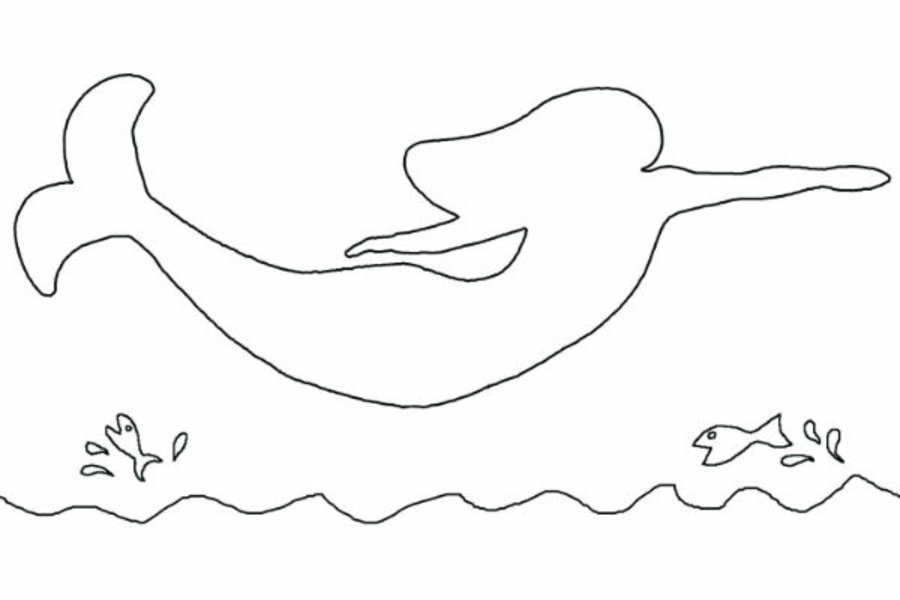
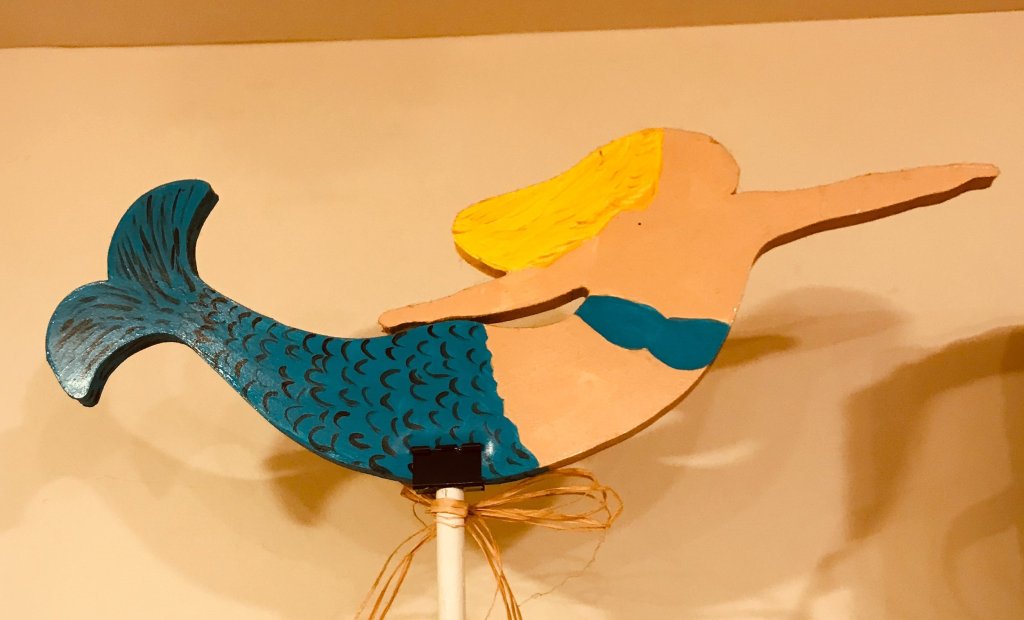
The city of Norfolk is a little obsessed with mermaids. Like Austin with their painted cows or Cleveland’s guitars, decorated mermaid statues show up in random places throughout the city. A lot of places around town also use mermaids in their decoration, including our house of Ron. Invariably the mermaid is in this position:
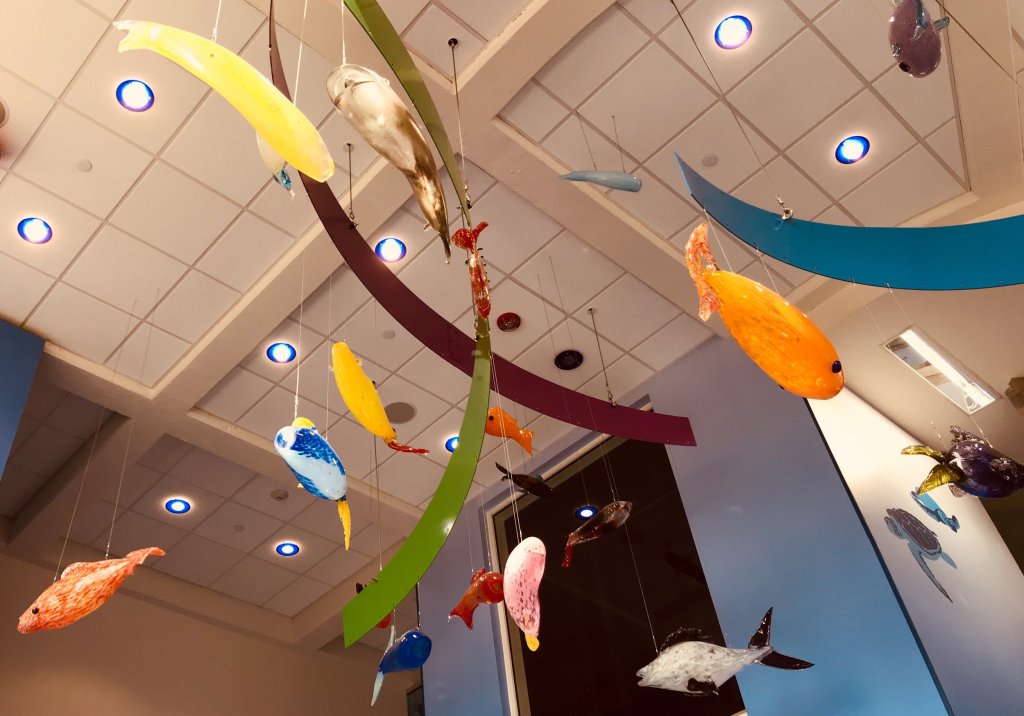
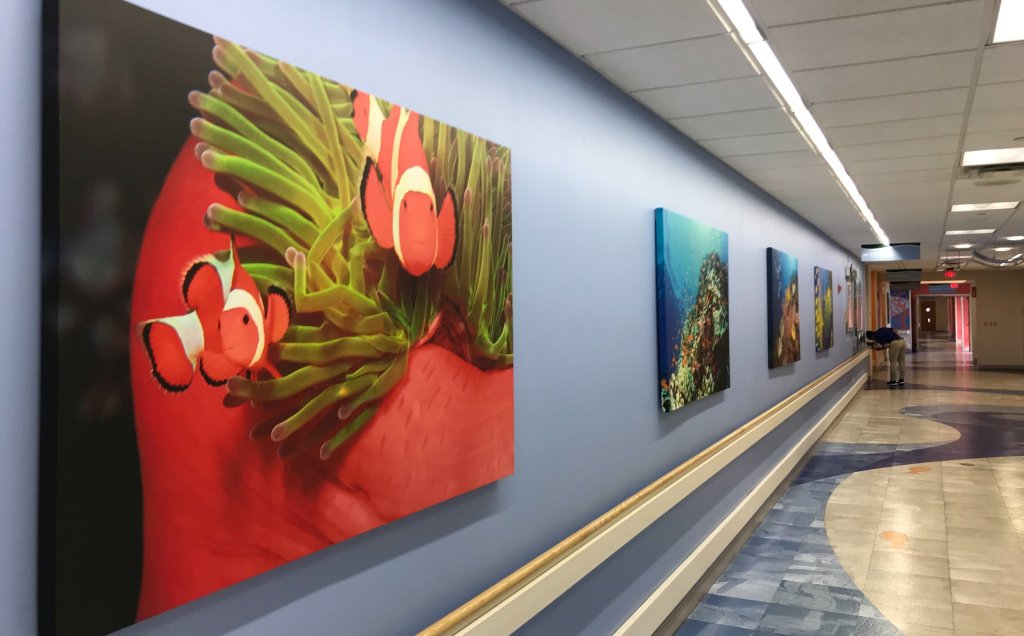
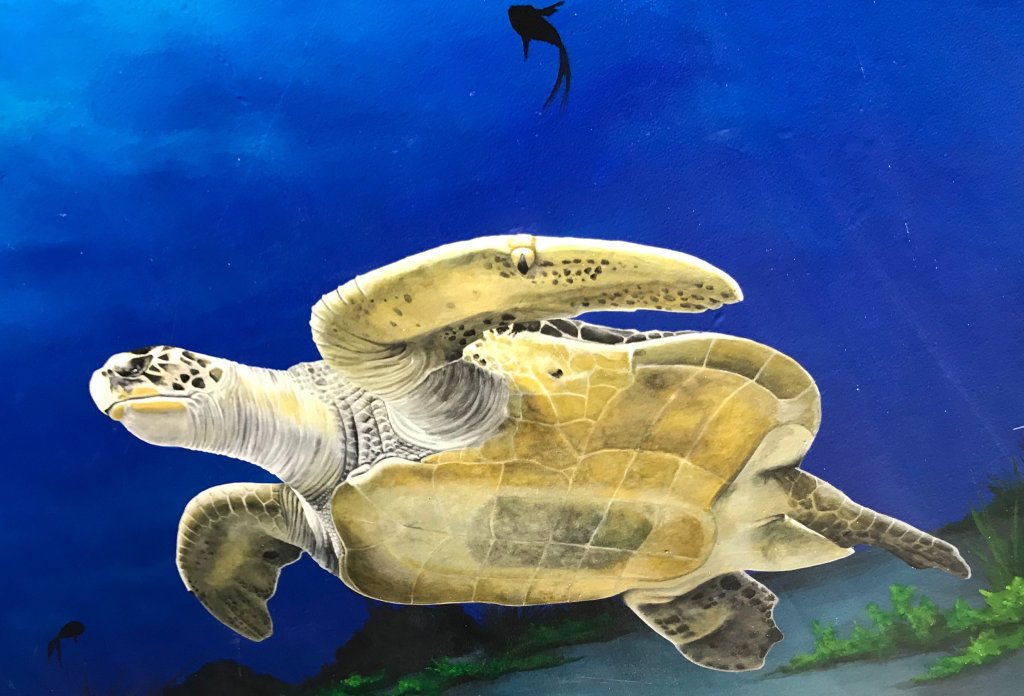
Our son’s hospital’s decor is ocean-themed, but for some reason there are no mermaids. At first I thought because they wanted to be a little more science-based, but then I looked at the inscription around the statue of children playing in front of the main entrance, which is from Peter Pan: “‘I say, how do you fly?’ ‘You just think lovely wonderful thoughts and they lift you up in the air.’”
Um, no, Peter. Not on this planet. On this planet there is no pixie dust, and there are no mermaids, and we use science to treat illness, science to heal wounds, to save babies, to build hospitals, and also by the way, to fucking fly.
Maybe the lack of mermaids in the hospital is just a licensing thing.
Last week a nurse was doing a routine chest exam on Alex with the stethoscope when she noticed a whooshing noise. She raised her head and without removing the prongs from her ears told us she heard a slight murmur in his heart. She said she suspected a PDA, which is excessively common among preterm births, like three out of four. I suspected another bad day was ready to take its turn. In most full-term newborns, the DA (Ductus Arteriosus), a connecting vessel between the aorta and the pulmonary artery, which in utero helps reroute oxygenated blood more efficiently, will close and sever after two or three days post-birth. Alex’s hasn’t closed yet. It remains Patent. It remains open.
An echocardiogram the next morning confirmed this. Also it showed a PFO (Patent Foramen Ovale), so actually my baby has another hole in his heart, but no one is concerned about this one. About 25% of all humans have this condition, the PFO, and most don’t know it. It’s a flap, not a vessel, not a shunt or a ductus, just a flap-covered hole between the left and right atria that exists for similar reasons as the DA, to let blood go in weird directions during fetal development. It too is supposed to close after birth. But the side effects of this hole tend to be minimal if any. So it’s all eyes on the PDA.
We do not like the PDA.

I have held my child twice now. The first time I was too shell-shocked to say much of anything to him. I just concentrated on keeping this kitten-sized human motionless and warm beneath the collar of my t-shirt and the receiving blanket and both my careful hands. There isn’t enough room for both of my hands, though, so it turns into holding one hand up with the other hand.
Today I held him for almost two hours. I had been looking forward to this for days, so when I got him I clung to him and cupped him to my chest and whispered and sang and murmured affirmations into his floppy ear. Sometimes I took one hand down, held my 550 gram child entirely in one palm, felt him squirm, his fingers tangled in my chest hair, straining to lift his head up and look around the place. He can do it, too. I wasn’t exactly flat on my back or anything, but he’s strong enough to best gravity and lift his head away from its resting place, if he wants to. I am achingly proud of this child.
I had been planning on holding him two days ago, but he’d had a bad night, they said when we arrived. His ventilator settings had been increased for the first time in four days, and they’ve been going up ever since, his lungs needing more and more support. He is on the verge of returning to the jet ventilator, which does the work for them entirely.
On the bright side, his antibiotic course has been successful thus far to the point that he’s off the contact protocol. No more paper gowns. And as I’ve mentioned, they did let me hold him today. So it’s not all bad news.
What to do about a PDA.
Well, first you can do nothing. That’s what we tried. His numbers were good, and recent studies haven’t been able to find a significant difference in long term outcomes for rushing to close every PDA you find. For about a week or so it seemed to be going fine. Then came the turn, so now it’s time to do something.
For years they’ve been using ibuprofen
to chemically treat the PDA and force it to close, but ibuprofen and its like drugs come with gastrointestinal risks, among a few other undesirable side effects. More recently, they’ve started using Tylenol
so universally that our doctors kept assuming Alex was put on Tylenol already as soon as the PDA was discovered. When the PDA took a turn, in fact, the doctor of the day immediately said our next step was surgical intervention. I was like, Whoa, hey, are we too late for trying the Tylenol?
He said, Yes, unfortunately. Then he looked around at his residents. Wait, did he have Tylenol yet?
After the results of Alex’s second echocardiogram came back yesterday, revealing a 2.1 mm (medium to large) shunt still open between the aorta and the pulmonary artery, they started him on the Tylenol. Five days after they could have. If it doesn’t work, and his symptoms don’t improve, they’ll want to go in surgically to close the shunt.
As frustrating as it is to have the hindsight now, I understand why they didn’t immediately prescribe the acetaminophen. If it’s not broke, don’t give it Tylenol. His blood gases were good. Golden, even. They had him on the fast track to jump to the next lower level of respirator, which is just a tube providing bonus oxygen through the nostrils. No more intubation, no more plastic bar holding it in place and blocking most of the lower half of his pretty face in photos. I could almost see it. His whole face.
Which isn’t to say he won’t get there eventually. His numbers aren’t so great anymore, but he’s looking good. He passes the eye test. And he’s strong as ever. Anytime you place a cold stethoscope on his chest, or poke his belly in a way he doesn’t appreciate, if you don’t have him all clamped down then he’ll come out swinging, karate-chopping, legs flung skyward and gyrating, his expression the definition of cross. All day today he was jumping, starting, twitching as though with hiccups but absent the regularity, testing his restraints, trying to make himself more comfortable, I thought. We’ve come to associate his blood-gas desaturation episodes (quickly dropping from acceptable levels in the 90s to the 70s or 60s) with him being fussy or uncomfortable, but today, towards the end, it started to seem to me like he could feel one of these desat episodes coming on and would fuss in response to it, trying to kick and punch his way into a position that would let him breathe the good air again. Suctioning his lungs doesn’t always pull out fluid, but I get the feeling it’s a hot mess in there and sometimes he’s got to shake himself up like a snow globe to free up some of those hungry alveoli and let them absorb oxygen again. While I was holding him, I did my feeble best to help, giving him one-finger pats on the back, as though he could burp, as though he’s ever had food not placed directly into his stomach with a tube.
He is three weeks and three days old and has yet to be allowed to completely close his mouth. There’s always been plastic in the way. For the duration of his life.

He will get better. I have no doubt. It’s just a phase, a stage, a small portion of the whole grand process, but a stage it pains me to watch, and makes me sad in ways I’m unfamiliar with. And I am fairly familiar with sadness.
I just looked up what Norfolk’s deal with mermaids is. Turns out, it dates back all the way to the year 2002 A.D., when the city purchased 130 identical cast-bronze mermaid sculptures left over from a 1999 event called the “Mermaid Parade,” about which pertinent details do not exist, and then convinced over 80 local businesses to buy one for themselves and paint it funny colors.
…Cool.




 Aaron M. Fortkamp
Leave a comment